Geographical analysis
Department of Geography & GIS
Department of Geography & GIS
Geographical analysis
DOI: 10.53989/bu.ga.v15.i1.133
Year: 2026, Volume: 15, Issue: 1, Pages: 37-49
Original Article
Rosa Fathi Karmoka1*
1General Organization of Remote Sensing, Damascus, Syria
*Corresponding author
Email: [email protected]
Received Date:29 October 2025, Accepted Date:07 August 2026
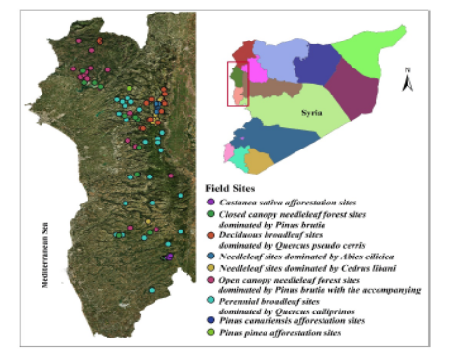
This study investigates the response of various forest canopy types in northwestern Syria to climatic drought using geospatial and statistical methods. By analyzing the Leaf Area Index (LAI) derived from NDVI and its correlation with the Standardized Precipitation Index (SPI) across nine dominant forest types over a 23-year period (2001–2022), the research quantifies the sensitivity of different vegetation communities to precipitation variability. The study reveals that forest types, with deciduous broadleaf species such as Quercus pseudo cerris and Castanea sativa exhibit wider LAI ranges and high correlation with SPI, indicating high responsiveness to drought conditions. Conversely, evergreen oaks (Quercus calliprinos) and Abies cilicica show more stability in canopy development with moderate to low correlations, reflecting greater resilience. Correlation coefficients (r) between LAI and SPI ranged from 0.29 to 0.67, highlighting notable differences in drought sensitivity across forest types. The methodology employed georeferenced sampling, statistical correlation, and LAI modeling based on NDVI, allowing a reliable long-term evaluation of forest canopy dynamics in relation to climatic stress. Findings underline the importance of considering canopy structure, species-specific traits, and site conditions in drought resilience assessments. The results suggest that native and well-adapted species may offer more stable ecosystem functioning under drought, while introduced or less adapted types might be more vulnerable. These insights provide valuable implications for developing forest management strategies aimed at promoting ecological stability, drought resilience, and the preservation of forest functions in climate-sensitive Mediterranean regions.
Keywords: Climate Change, Forest Cover Type, Leaf area Index LAI, Standardized Precipitation Index SPI, Syria Forests
1. Allen CD, Macalady AK, Chenchouni H, Bachelet D, McDowell N, Vennetier M, et al. A global overview of drought and heat-induced tree mortality reveals emerging climate change risks for forests. Forest Ecology and Management. 2010; 259 (4). Available from: https://doi.org/10.1016/j.foreco.2009.09.001
2. Gouveia CM, Trigo RM, Beguería S, Vicente-Serrano SM. Drought impacts on vegetation activity in the Mediterranean region: An assessment using remote sensing data and multi-scale drought indicators. Global and Planetary Change. 2017; 151 Available from: https://doi.org/10.1016/j.gloplacha.2016.06.011
3. FAO, Plan Bleu. State of Mediterranean Forests (SoMF). Concept Paper. Available from: https://planbleu.org/en/publications/state-of-mediterranean-forests-2013/
4. Carnicer J, Coll M, Ninyerola M, Pons X, Sánchez G, Peñuelas J. Widespread crown condition decline, food web disruption, and amplified tree mortality with increased climate change-type drought. Proceedings of the National Academy of Sciences. 2011; 108 (4). Available from: https://doi.org/10.1073/pnas.1010070108
5. Gómez-González S, Ojeda F, Fernandes PM. Portugal and Chile: Longing for sustainable forestry while rising from the ashes. Environmental Science & Policy. 2018; 81 Available from: https://doi.org/10.1016/j.envsci.2017.11.006
6. Peñuelas J, Sardans J, Filella I, Estiarte M, Llusià J, Ogaya R, et al. Impacts of Global Change on Mediterranean Forests and Their Services. Forests. 2017; 8 (12). Available from: https://doi.org/10.3390/f8120463
7. Saatchi SS, Harris NL, Brown S, Lefsky M, Mitchard ET, Salas W, et al. Benchmark map of forest carbon stocks in tropical regions across three continents. Proceedings of the National Academy of Sciences. 2011; 108 (24). Available from: https://doi.org/10.1073/pnas.1019576108
8. Adhikari S, Zhou W, Dou Z, Sakib N, Ma R, Chaudhari B, et al. Analysis of Flash Drought and Its Impact on Forest Normalized Difference Vegetation Index (NDVI) in Northeast China from 2000 to 2020. Atmosphere. 2024; 15 (7). Available from: https://doi.org/10.3390/atmos15070818
9. Agarwal V, Vishvendra Raj Singh B, Marsh S, Qin Z, Sen A, Kulhari K. Integrated Remote Sensing for Enhanced Drought Assessment: A Multi‐Index Approach in Rajasthan, India. Earth and Space Science. 2025; 12 (2). Available from: https://doi.org/10.1029/2024ea003639
10. Domingo AS, Javier C, Paruelo Jose M, Miguel D. Trends in the surface vegetation dynamics of the national parks of Spain as observed by satellite sensors. Applied Vegetation Science. 2008; 11 (4). Available from: https://doi.org/10.3170/2008-7-18522
11. Eastman J, Sangermano F, Machado E, Rogan J, Anyamba A, Eastman JR, et al. Global Trends in Seasonality of Normalized Difference Vegetation Index (NDVI), 1982–2011. Remote Sensing. 2013; 5 (10). Available from: https://doi.org/10.3390/rs5104799
12. Khorchani M, Vicente-Serrano SM, Azorin-Molina C, Garcia M, Martin-Hernandez N, Peña-Gallardo M, et al. Trends in LST over the peninsular Spain as derived from the AVHRR imagery data. Global and Planetary Change. 2018; 166 Available from: https://doi.org/10.1016/j.gloplacha.2018.04.006
13. Gouveia CM, Bastos A, Trigo RM, Dacamara CC. Drought impacts on vegetation in the pre- and post-fire events over Iberian Peninsula. Natural Hazards and Earth System Sciences. 2012; 12 (10). Available from: https://doi.org/10.5194/nhess-12-3123-2012
14. Vicente-Serrano SM, Tomas-Burguera M, Beguería S, Reig F, Latorre B, Peña-Gallardo M, et al. A High Resolution Dataset of Drought Indices for Spain. Data. 2017; 2 (3). Available from: https://doi.org/10.3390/data2030022
15. Nimmo DG, Mac Nally R, Cunningham SC, Haslem A, Bennett AF. Vive la résistance: reviving resistance for 21st century conservation. Trends in Ecology & Evolution. 2015; 30 (9). Available from: https://doi.org/10.1016/j.tree.2015.07.008
16. Ogaya R, Barbeta A, Başnou C, Peñuelas J. Satellite data as indicators of tree biomass growth and forest dieback in a Mediterranean holm oak forest. Annals of Forest Science. 2015; 72 (1). Available from: https://doi.org/10.1007/s13595-014-0408-y
17. Guiot J, Cramer W. Climate change: The 2015 Paris Agreement thresholds and Mediterranean basin ecosystems. Science. 2016; 354 (6311). Available from: https://doi.org/10.1126/science.aah5015
18. Cramer W, Guiot J, Fader M, Garrabou J, Gattuso JP, Iglesias A, et al. Climate change and interconnected risks to sustainable development in the Mediterranean. Nature Climate Change. 2018; 8 (11). Available from: https://doi.org/10.1038/s41558-018-0299-2
19. UNEP/MAP. Mediterranean Strategy for Sustainable Development 2016-2025. Valbonne. Plan Bleu, Regional Activity Centre. 2016; Available from: https://wedocs.unep.org/20.500.11822/7700
20. Anderegg WR, Kane JM, Anderegg LD. Consequences of widespread tree mortality triggered by drought and temperature stress. Nature Climate Change. 2013; 3 (1). Available from: https://www.nature.com/articles/nclimate1635
21. Lloret F, Keeling EG, Sala A. Components of tree resilience: effects of successive low‐growth episodes in old ponderosa pine forests. Oikos. 2011; 120 (12). Available from: https://doi.org/10.1111/j.1600-0706.2011.19372.x
22. Myneni RB, Hoffman S, Knyazikhin Y, Privette JL, Glassy J, Tian Y, et al. Global products of vegetation leaf area and fraction absorbed PAR from year one of MODIS data. Remote Sensing of Environment. 2002; 83 (1-2). Available from: https://doi.org/10.1016/s0034-4257(02)00074-3
23. De la Guerra MM, Martínez Alandi C, Atauri Mezquida JA, GómezLimón García J, Puertas Blázquez J, García Ventura D. (2017). EUROPARC-España. 2017 Anuario 2016 del estado de las áreas protegidas en España. In Espacios FIPL & Bernáldez NFG (Eds.). Madrid. Fundación Interuniversitaria Fernando González Bernáldez para los espacios naturales
24. Gavinet J, Prévosto B, Fernandez C. Introducing resprouters to enhance Mediterranean forest resilience: importance of functional traits to select species according to a gradient of pine density. Journal of Applied Ecology. 2016; 53 (6). Available from: https://doi.org/10.1111/1365-2664.12716
25. Martín-Alcón S, Coll L, Salekin S. Stand-level drivers of tree-species diversification in Mediterranean pine forests after abandonment of traditional practices. Forest Ecology and Management. 2015; 353 Available from: https://doi.org/10.1016/j.foreco.2015.05.022
26. Yin J, Bauerle TL. A global analysis of plant recovery performance from water stress. Oikos. 2017; 126 (10). Available from: https://doi.org/10.1111/oik.04534
27. Karmoka R. Estimating average age and tree density of Jobet berghal Pinus brutia Ten. Forests Using Landsat images, The Arab Journal for Arid Environments / The Arab Center for the Studies of Arid Zones and Dry Lands (ACSAD). 2022; Available from: https://dx.doi.org/10.13140/RG.2.2.26507.50722
28. Asrar G, Myneni RB, Kanemasu ET. Estimation of plant canopy attributes from spectral reflectance measurements. In Asrar G (Ed.), Theory and applications of optical remote sensing. New York: Wiley. 1989; Available from: https://books.google.co.uk
29. Carlson TN, Ripley DA. On the relation between NDVI, fractional vegetation cover, and leaf area index. Remote Sensing of Environment. 1997; 62 (3). Available from: https://doi.org/10.1016/s0034-4257(97)00104-1
30. Cihlar J, St.-Laurent L, Dyer JA. Relation between the normalized difference vegetation index and ecological variables. Remote Sensing of Environment. 1991; 35 (2-3). Available from: https://doi.org/10.1016/0034-4257(91)90018-2
31. Tucker CJ, Sellers PJ. Satellite remote sensing of primary production. International Journal of Remote Sensing. 1986; 7 (11). Available from: https://doi.org/10.1080/01431168608948944
32. Zhang X, Friedl MA, Schaaf CB, Strahler AH, Hodges JCF, Gao F, et al. Monitoring vegetation phenology using MODIS. Remote Sensing of Environment. 2003; 84 (3). Available from: https://doi.org/10.1016/s0034-4257(02)00135-9
33. Gazol A, Camarero JJ, Vicente-Serrano SM, Sánchez-Salguero R, Gutiérrez E, de Luis M, et al. Quantifying tree mortality in a mixed species woodland using multitemporal high spatial resolution satellite imagery. Remote Sensing of Environment. 2013; 129 (5). Available from: https://doi. org/10.1016/j.rse.2012.10.029
34. Anderegg WRL, Schwalm C, Biondi F, Camarero JJ, Koch G, Litvak M, et al. Forest resilience to drought varies across biomes. Global Change Biology. 2018; 24 (5). Available from: https://doi.org/10.1111/gcb.14082
35. Anderegg WRL, Schwalm C, Biondi F, Camarero JJ, Koch G, Litvak M, et al. Pervasive drought legacies in forest ecosystems and their implications for carbon cycle models. Science. 2015; 349 (6247). Available from: https://doi.org/10.1126/science.aab1833
36. Peltier DMP, Fell M, Ogle K. Legacy effects of drought in the southwestern United States: A multi‐species synthesis. Ecological Monographs. 2016; 86 (3). Available from: https://doi.org/10.1002/ecm.1219
37. Xiao X, Zhang Q, Saleska S, Hutyra L, De Camargo P, Wofsy S, et al. Satellite-based modeling of gross primary production in a seasonally moist tropical evergreen forest. Remote Sensing of Environment. 2005; 94 (1). Available from: https://doi.org/10.1016/j.rse.2004.08.015
38. Zhu Z, Bi J, Pan Y, Ganguly S, Anav A, Xu L, et al. Global data sets of vegetation LAI 3g and FPAR 3g derived from GIMMS normalized difference vegetation index (NDVI) 3g for the period 1981 to 2011. Remote Sensing. 2013; 5 (2). Available from: https://doi.org/10.3390/rs5020927
39. Turner DP, Cohen WB, Kennedy RE. Alternative spatial resolutions and estimation of carbon flux over a managed forest landscape in western Oregon. Landscape Ecology. 2000; 15 (5). Available from: https://doi.org/10.1023/a:1008116300063
40. Tian Y, Dickinson RE, Zhou L, Zeng X, Dai Y, Myneni RB, et al. Comparison of seasonal and spatial variations of leaf area index and fraction of absorbed photosynthetically active radiation from Moderate Resolution Imaging Spectroradiometer (MODIS) and Common Land Model. Journal of Geophysical Research: Atmospheres. 2004; 109 (D1). Available from: https://doi.org/10.1029/2003jd003777
41. Carlson TN, Ripley DA. On the relation between NDVI, fractional vegetation cover, and leaf area index. Remote Sensing of Environment. 1997; 62 (3). Available from: https://doi.org/10.1016/s0034-4257(97)00104-1
42. Mutanga O, Skidmore AK. Narrow band vegetation indices overcome the saturation problem in biomass estimation. International journal of remote sensing. 2004; 25 (19). Available from: https://doi.org/10.1080/01431160310001654923
43. Guttman NB. Comparing the palmer drought index and the standardized precipitation index 1. JAWRA Journal of the American Water Resources Association. 1998; 34 (1). Available from: https://doi.org/10.1111/j.1752-1688.1998.tb05964.x
44. Mc Kee TB, Doesken NJ, Kleist J. The relationship of drought frequency and duration to time scales. Proceedings of the 8th Conference on Applied Climatology. 1993, 17(22). pp. 179-183
45. Zhou Z, Ding Y, Fu Q, Wang C, Wang Y, Cai H, et al. Comprehensive evaluation of vegetation responses to meteorological drought from both linear and nonlinear perspectives. Frontiers in Earth Science. 2022; 10 Available from: https://doi.org/10.3389/feart.2022.953805
46. Christopoulou A, Sazeides CI, Fyllas NM. Size-mediated effects of climate on tree growth and mortality in Mediterranean Brutia pine forests. Science of The Total Environment. 2021; 800 Available from: https://doi.org/10.1016/j.scitotenv.2021.151463
47. Gazol A, Oliva J, Valeriano C, Colangelo M, Camarero JJ. Mixed Pine Forests in a Hotter and Drier World: The Great Resilience to Drought of Aleppo Pine Benefits It Over Other Coexisting Pine Species. Frontiers in Forests and Global Change. 2022; 5 Available from: https://doi.org/10.3389/ffgc.2022.899425
48. Ramírez‑Valiente JA, Aranda I, Sanchéz‑Gómez D, Rodríguez‑Calcerrada J, Valladares F, et al. Regulation of transpirational water loss in Quercus suber and Quercus ilex trees in a Mediterranean‑type ecosystem. Tree Physiology. 2019; 39 (1). Available from: https://doi.org/10.1093/treephys/tpy084
49. Galle A, Florez-Sarasa I, El Aououad H, Flexas J. The Mediterranean evergreen Quercus ilex and the semi-deciduous Cistus albidus differ in their leaf gas exchange regulation and acclimation to repeated drought and re-watering cycles. Journal of Experimental Botany. 2011; 62 (14). Available from: https://doi.org/10.1093/jxb/err233
50. Mazza G, Monteverdi MC, Altieri S, Battipaglia G. Climate-driven growth dynamics and trend reversal of Fagus sylvatica L. and Quercus cerris L. in a low-elevation beech forest in Central Italy. Science of The Total Environment. 2024; 908 Available from: https://doi.org/10.1016/j.scitotenv.2023.168250
51. Zsolnay N, Walentowitz A, Aas G. Impact of climatic conditions on radial growth of non-native Cedrus libani compared to native conifers in Central Europe. PLOS ONE. 2023; 18 (5). Available from: https://doi.org/10.1371/journal.pone.0275317
52. Güney A, Zweifel R, Türkan S, Zimmermann R, Wachendorf M, Güney CO. Drought responses and their effects on radial stem growth of two co-occurring conifer species in the Mediterranean mountain range. Annals of Forest Science. 2020; 77 (4). Available from: https://doi.org/10.1007/s13595-020-01007-2
53. Brito P, Lorenzo JR, González‑Rodríguez ÁM, Morales D, Wieser G, Jiménez MS. Canopy transpiration of a Pinus canariensis forest at the tree line: implications for its distribution under predicted climate warming. European Journal of Forest Research. 2014; 133 (3). Available from: https://doi.org/10.1007/s10342-014-0779-5
54. Brito P, Lorenzo JR, González‑Rodríguez ÁM, Morales D, Wieser G, Jiménez MS. Increased water use efficiency does not prevent growth decline of Pinus canariensis in a semi-arid treeline ecotone in Tenerife, Canary Islands (Spain). Annals of Forest Science. 2016; 73 (3). Available from: https://doi.org/10.1007/s13595-016-0562-5
55. Férriz M, Martin‑Benito D, Fernández‑de‑Simón MB, Conde M, García‑Cervigón AI, Gea‑Izquierdo G, et al. Functional phenotypic plasticity mediated by water stress and [CO2] explains differences in drought tolerance of two phylogenetically close conifers. Tree Physiology. 2023; 43 (6). Available from: https://doi.org/10.1093/treephys/tpad021
56. George JP, Schueler S, Karanitsch-Ackerl S, Mayer K, Klumpp RT, et al. Inter- and intra-specific variation in drought sensitivity in Abies spec. and its relation to wood density and growth traits. Agricultural and Forest Meteorology. 2015; 214-215 Available from: https://doi.org/10.1016/j.agrformet.2015.08.268
57. Wang M, Chen JM, Wang S. Reconstructing the Seasonality and Trend in Global Leaf Area Index During 2001–2017 for Prognostic Modeling. Journal of Geophysical Research: Biogeosciences. 2020; 125 (9). Available from: https://doi.org/10.1029/2020jg005698
58. Peña-Gallardo M, Vicente-Serrano SM, Camarero JJ, Gazol A, Sánchez-Salguero R, Domínguez-Castro F, et al. Drought Sensitiveness on Forest Growth in Peninsular Spain and the Balearic Islands. Forests. 2018; 9 (9). Available from: https://doi.org/10.3390/f9090524
59. Zhao Z, Zhang Y, Liu L, Hu Z. The impact of drought on vegetation conditions within the Damqu River Basin, Yangtze River Source Region, China. PLOS ONE. 2018; 13 (8). Available from: https://doi.org/10.1371/journal.pone.0202966
© 2026 Karmoka. This is an open-access article distributed under the terms of the Creative Commons Attribution License, which permits unrestricted use, distribution, and reproduction in any medium, provided the original author and source are credited.
Published By Bangalore University, Bengaluru, Karnataka
Subscribe now for latest articles and news.