Geographical analysis
Department of Geography & GIS
Department of Geography & GIS
Geographical analysis
Year: 2026, Volume: 15, Issue: 1, Pages: 75-83
Original Article
Ashok Kumar1, B Mahalingam2, Arava Satya Saichanti3*
1Associate Professor, Department of Geography, School of Earth Sciences, Central University of Karnataka, Kalaburagi- 585367, Karnataka, India.
2Assistant Professor, Department of Geography, School of Earth Sciences, Central University of Karnataka, Kalaburagi- 585367, Karnataka, India.
3Research Scholar, Department of Geography, School of Earth Sciences, Central University of Karnataka, Kalaburagi- 585367, Karnataka, India.
*Corresponding author
Email: [email protected]
Received Date:20 April 2026, Accepted Date:21 August 2026
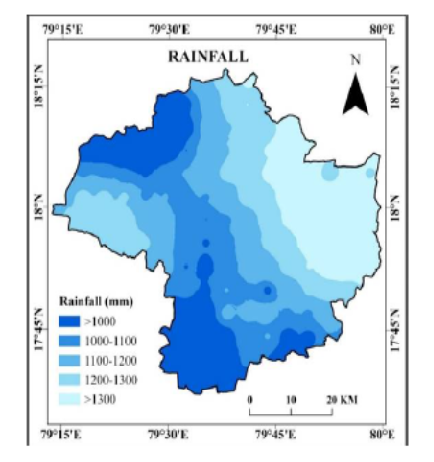
The process of finding appropriate landfill locations serves as an essential requirement that guarantees environmentally responsible waste treatment methods. The research establishes landfill site suitability through geospatial analysis in Warangal District, India, which uses multi-criteria decision-making methods. The study evaluated multiple environmental and socio-economic factors, which included slope elevation, rainfall, land use/land cover, and distances to settlements, roads, and railways and lineaments. The Analytical Hierarchy Process (AHP) enabled weight distribution to be executed through assessment of criterion significance, and the final suitability map was produced through weighted overlay analysis. The study area contains only 2.52 square kilometers, which represents 0.09 percent of the area that meets requirements for landfill development while approximately 316.90 square kilometers of land demonstrates moderate suitability. The majority of the region falls under not suitable zones due to the presence of settlements, agricultural land and environmental constraints. The study results show that suitable landfill sites exist in limited supply which creates a requirement for proper waste management planning. The framework established through this research enables proper landfill site selection which promotes effective waste management in areas that experience fast urban development.
Keywords: Landfill, Geospatial analysis, AHP, Weighted overlay, GIS, Suitability analysis, Solid Waste, Decision making, Slope elevation, Suitable zone
1. Central Pollution Control Board (CPCB). Solid Waste Management Rules. 2016; Available from: https://cpcb.nic.in/uploads/MSW/SWM_2016.pdf
2. Dolui G, Chatterjee B. Application of AHP in decision making. Materials Today: Proceedings. 2019; 18 Available from: https://doi.org/10.1016/j.matpr.2019.06.129
3. Eastman JR. (1999). Multi-criteria evaluation and GIS. In Geographical Information Systems.
4. El-Fadel M, Findikakis AN, Leckie JO. Environmental Impacts of Solid Waste Landfilling. Journal of Environmental Management. 1997; 50 (1). Available from: https://doi.org/10.1006/jema.1995.0131
5. Ferronato N, Torretta V. Waste Mismanagement in Developing Countries: A Review of Global Issues. International Journal of Environmental Research and Public Health. 2019; 16 (6). Available from: https://doi.org/10.3390/ijerph16061060
6. Funk C, Peterson P, Landsfeld M, Pedreros D, Verdin J, Shukla S, et al. The climate hazards infrared precipitation with stations—a new environmental record for monitoring extremes. Scientific Data. 2015; 2 (1). Available from: https://doi.org/10.1038/sdata.2015.66
7. Gbanie SP, Tengbe PB, Momoh JS, Medo J, Kabba VTS. Modelling landfill location using GIS. Journal of Geographic Information System. 2013; 5 Available from: https://doi.org/10.4236/jgis.2013.56058
8. Hoornweg D, Bhada-Tata P. (2012). What a Waste. World Bank.
9. Kaza S, Yao L, Bhada-Tata P, Van Woerden F. What a Waste 2.0. World Bank. 2018; Available from: https://doi.org/10.1596/978-1-4648-1329-0
10. Kontos TD, Komilis DP, Halvadakis CP. Siting MSW landfills with a spatial multiple criteria analysis methodology. Waste Management. 2005; 25 (8). Available from: https://doi.org/10.1016/j.wasman.2005.04.002
11. Lin HY, Kao JJ. Enhanced Spatial Model for Landfill Siting Analysis. Journal of Environmental Engineering. 1999; 125 (9). Available from: https://doi.org/10.1061/(asce)0733-9372(1999)125:9(845)
12. Malczewski J. GIS-based land-use suitability analysis: a critical overview. Progress in Planning. 2004; 62 (1). Available from: https://doi.org/10.1016/j.progress.2003.09.002
13. Nas B, Cay T, Iscan F, Berktay A. Selection of MSW landfill site for Konya, Turkey using GIS and multi-criteria evaluation. Environmental Monitoring and Assessment. 2010; 160 (1-4). Available from: https://doi.org/10.1007/s10661-008-0713-8
14. Rahmat ZG, Niri MV, Alavi N, et al. Landfill site selection using GIS and AHP. Environmental Monitoring and Assessment. 2017; 189 Available from: https://doi.org/10.1007/s10661-017-5816-6
15. Saaty TL. (1980). The analytic hierarchy process. McGraw-Hill.
16. Şener E, Şener Ş, Nas B. GIS-based landfill site selection. Environmental Earth Sciences. 2010; 59 Available from: https://doi.org/10.1007/s12665-009-0076-2
17. Şener Ş, Şener E, Nas B. Selecting landfill sites using GIS and multi-criteria evaluation. Environmental Earth Sciences. 2011; 65 Available from: https://doi.org/10.1007/s12665-011-1145-4
18. Sharholy M, Ahmad K, Mahmood G, Trivedi RC. Municipal solid waste management in Indian cities – A review. Waste Management. 2008; 28 (2). Available from: https://doi.org/10.1016/j.wasman.2007.02.008
19. Sumathi VR, Natesan U, Sarkar C. GIS-based approach for landfill site selection. Journal of Environmental Management. 2008; 87 (1). Available from: https://doi.org/10.1016/j.jenvman.2007.01.013
20. Tchobanoglous G, Theisen H, Vigil S. (1993). Integrated solid waste management. McGraw-Hill
21. Adnan Ozdemir. Landslide susceptibility mapping of vicinity of Yaka Landslide (Gelendost, Turkey) using conditional probability approach in GIS. Environmental Geology. 2009; 57 (7). Available from: https://doi.org/10.1007/s00254-008-1449-z
22. Yesilnacar MI, Cetin H. Site selection for landfill using GIS. Environmental Geology. 2005; 47 Available from: https://doi.org/10.1007/s00254-004-1161-9
© 2026 Kumar, et al. This is an open-access article distributed under the terms of the Creative Commons Attribution License, which permits unrestricted use, distribution, and reproduction in any medium, provided the original author and source are credited.
Published By Bangalore University, Bengaluru, Karnataka
Subscribe now for latest articles and news.