Geographical analysis
Department of Geography & GIS
Department of Geography & GIS
Geographical analysis
DOI: 10.53989/bu.ga.v15.i1.102
Year: 2026, Volume: 15, Issue: 1, Pages: 60-63
Original Article
Dnyaneshwar S Suryawanshi1, Asha M Kate2*, Kailas V Patil3
1Professor & Head, Post Graduate Research Centre, Department of Geography, VWS Dr. M.Y. Vaidhya Arts, Prof P.D. Dalal Commerce & Dr. D.S. Shah Science College, Dhule, Maharashtra, India.
2Assistant Professor, Post Graduate Research Centre, Department of Geography, VWS Dr. M.Y. Vaidhya Arts, Prof P.D. Dalal Commerce & Dr. D.S. Shah Science College, Dhule, Maharashtra, India.
3Research scholar, Post Graduate Research Centre, Department of Geography, VWS Dr. M.Y. Vaidhya Arts, Prof P.D. Dalal Commerce & Dr. D.S. Shah Science College, Dhule, Maharashtra, India
*Corresponding author
Email: [email protected]
Received Date:08 July 2025, Accepted Date:07 August 2026
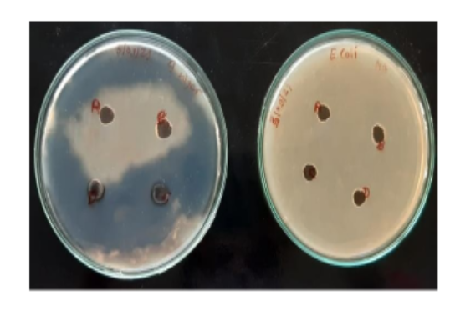
Geopharmacology is an emerging and novel branch of research in Geography of Health. The word Geopharmacology consists of two words, i.e., one is Geography and another is Pharmacology, in which geographical components or elements are studied from pharmaceutical and medicinal point of views. These points of views are useful for the wellness of human being. Hot spring is one of the core components of geopharmacological research. Khandesh is province of Maharashtra state in India. It’s having reach geoheritage from ancient era and hot springs are one of them. For this research study, hot springs water samples are collected from Ramtalab hot springs and tested for antimicrobial activity using agar diffusion method. For testing the antimicrobial activity of hot spring water sample, 1 bacterial (Gram positive and Gram negative) and 2 fungal strains are used, to detect the versatility of water against each type of microorganism. The organisms used in the activity are E. coli, S. aureus Bacteria) and A. niger and C. albicans (Fungi). Results revealed on the basis of temperature, and pH, hot springs in Khandesh province came in category of hyper thermal hot springs and an alkaline hot springs in nature. antimicrobial study shows that, hot springs water samples are potential antimicrobial activity against fungal strains special A. niger, C. albicansare responsible for various skin diseases to human. Hence, these water samples can be used in the preparation of formulations against human skin diseases and very high potential properties recorded as new hope rays for balenotherapy centers in Khandesh region of Northern Maharashtra state in India.
Keywords: Geopharmacology, Geoheritage antimicrobial, Balenotherapy, Sustainable
1. Das P, Maya K, Padmalal D. Hydrogeochemistry of the Indian thermal springs: Current status. Earth-Science Reviews. 2022; 224 Available from: https://doi.org/10.1016/j.earscirev.2021.103890
2. Suryawanshi DS, Patil KV. Physicochemical and heavy metals-contents Analysis of hot springs water in Khandesh province of Northern Maharashtra for balneotherapy. International Journal of Engineering, Management and Humanities. 2024; 5 (6). Available from: https://ijemh.com/issue_dcp/Physicochemical%20and%20Heavy%20metals%20contents%20Analysis%20of%20hot%20springs%20water%20in%20Khandesh%20province%20of%20Northern%20Maharashtra%20for%20balneotherapy.pdf
3. Suryawanshi DS, Patil KV. Exploring the future potential of balneotherapy at Unapdev hot spring in Khandesh of Maharashtra, India. Journal of Humanities and Social Science. 2024; 29 (9). Available from: https://doi.org/10.9790/0837-2909060104
4. Suryawanshi DS, Patil KV. Geo-pharmacology: hydrotherapy for health tourism. B. Aadhar International Peer Reviewed Indexed Research Journal. 2025; (DIII)503-C Available from: https://www.researchgate.net/publication/389399373_Geo-pharmacology_hydrotherapy_for_health_tourism
5. Suryawanshi DS, Patil KV. Sustainable Development through hot springs based tourism : economic opportunities for tribal and rural women in Khanesh. Discourse Analysis an International Refereed Journal. 2025; 15 (1). Available from: https://www.researchgate.net/publication/391370714_Sustainable_Development_through_hot_springs_based_tourism_economic_opportunities_for_tribal_and_rural_women_in_Khanesh
6. Suryawanshi DS, Kate AM, Patil KV. Hot Springs: A New Hope Ray for Medical Tourism in Maharashtra State. Geo-Eye. 2024; 13 (2). Available from: https://doi.org/10.53989/bu.ge.v13i2.43
7. Erfurt-Cooper P, Cooper M. Health and wellness tourism: Spas and hot springs. 2009; 40 Available from: https://doi.org/10.21832/9781845411138
8. Gupta ML, Sukhija BS. Preliminary studies of some geothermal areas in India. Geothermics. 1974; 3 (3). Available from: https://doi.org/10.1016/0375-6505(74)90004-2
9. Hermon D. Epistemology of Geography. Geography of the Physical Environment. 2022; Available from: https://doi.org/10.1007/978-3-031-07113-3_1
10. Matz H, Orion E, Wolf R. Balneotherapy in dermatology. Dermatologic Therapy. 2003; 16 (2). Available from: https://doi.org/10.1046/j.1529-8019.2003.01622.x
11. Mourelle ML, Gómez CP, Legido JL. Hydrobiome of Thermal Waters: Potential Use in Dermocosmetics. Cosmetics. 2023; 10 (4). Available from: https://doi.org/10.3390/cosmetics10040094
12. Suryawanshi DS, Pawar K, Patil KV. Hot spring: classification and situation in India. International Research Journal of Geography Maharashtra Bhugolshastra Sanshodhan Patrika. 2019; 36 (1). Available from: https://www.researchgate.net/publication/337533525_Hot_Springs_Classification_and_Situation_in_India
© 2026 Suryawanshi, et al. This is an open-access article distributed under the terms of the Creative Commons Attribution License, which permits unrestricted use, distribution, and reproduction in any medium, provided the original author and source are credited.
Published By Bangalore University, Bengaluru, Karnataka
Subscribe now for latest articles and news.